 Add to Chrome
 Add to Firefox
 Add to Edge
Do Coding Agents Understand Least-Privilege Authorization?
May 14, 2026
As coding agents gain access to shells, repositories, and user files, least-privilege authorization becomes a prerequisite for safe deployment: an agent should receive enough authority to complete the task, without unnecessary authority that exposes sensitive surfaces.To study whether current models can infer this boundary themselves, we first introduce permission-boundary inference, where a model maps a task instruction and terminal environment to a file-level read/write/execute policy, and AuthBench, a benchmark of 120 realistic terminal tasks with human-reviewed permission labels and executable validators for utility and attack outcomes.AuthBench shows that authorization is not a simple conservative-versus-permissive calibration problem: frontier models often omit permissions required by the execution chain while also granting unused or sensitive accesses.Increasing inference-time reasoning does not resolve this mismatch. Instead, each model moves toward a model-specific authorization attractor: more reasoning makes it more consistent in its own failure mode, whether broad-but-exposed or tight-but-brittle.This suggests that direct policy generation is the bottleneck, because a single generation must both discover all necessary accesses and reject all unnecessary ones.We therefore propose Sufficiency-Tightness Decomposition, which first generates a coverage-oriented policy by forward-simulating the task and then audits each granted entry for grounding and sensitivity.Across tested models, this decomposition improves sensitive-task success by up to 15.8% on tightness-biased models while reducing attack success across all evaluated models.

ClawMark: A Living-World Benchmark for Multi-Turn, Multi-Day, Multimodal Coworker Agents
Apr 26, 2026Language-model agents are increasingly used as persistent coworkers that assist users across multiple working days. During such workflows, the surrounding environment may change independently of the agent: new emails arrive, calendar entries shift, knowledge-base records are updated, and evidence appears across images, scanned PDFs, audio, video, and spreadsheets. Existing benchmarks do not adequately evaluate this setting because they typically run within a single static episode and remain largely text-centric. We introduce \bench{}, a benchmark for coworker agents built around multi-turn multi-day tasks, a stateful sandboxed service environment whose state evolves between turns, and rule-based verification. The current release contains 100 tasks across 13 professional scenarios, executed against five stateful sandboxed services (filesystem, email, calendar, knowledge base, spreadsheet) and scored by 1537 deterministic Python checkers over post-execution service state; no LLM-as-judge is invoked during scoring. We benchmark seven frontier agent systems. The strongest model reaches 75.8 weighted score, but the best strict Task Success is only 20.0\%, indicating that partial progress is common while complete end-to-end workflow completion remains rare. Turn-level analysis shows that performance drops after the first exogenous environment update, highlighting adaptation to changing state as a key open challenge. We release the benchmark, evaluation harness, and construction pipeline to support reproducible coworker-agent evaluation.
MuSEAgent: A Multimodal Reasoning Agent with Stateful Experiences
Mar 29, 2026Research agents have recently achieved significant progress in information seeking and synthesis across heterogeneous textual and visual sources. In this paper, we introduce MuSEAgent, a multimodal reasoning agent that enhances decision-making by extending the capabilities of research agents to discover and leverage stateful experiences. Rather than relying on trajectory-level retrieval, we propose a stateful experience learning paradigm that abstracts interaction data into atomic decision experiences through hindsight reasoning. These experiences are organized into a quality-filtered experience bank that supports policy-driven experience retrieval at inference time. Specifically, MuSEAgent enables adaptive experience exploitation through complementary wide- and deep-search strategies, allowing the agent to dynamically retrieve multimodal guidance across diverse compositional semantic viewpoints. Extensive experiments demonstrate that MuSEAgent consistently outperforms strong trajectory-level experience retrieval baselines on both fine-grained visual perception and complex multimodal reasoning tasks. These results validate the effectiveness of stateful experience modeling in improving multimodal agent reasoning.
Gym-V: A Unified Vision Environment System for Agentic Vision Research
Mar 17, 2026As agentic systems increasingly rely on reinforcement learning from verifiable rewards, standardized ``gym'' infrastructure has become essential for rapid iteration, reproducibility, and fair comparison. Vision agents lack such infrastructure, limiting systematic study of what drives their learning and where current models fall short. We introduce \textbf{Gym-V}, a unified platform of 179 procedurally generated visual environments across 10 domains with controllable difficulty, enabling controlled experiments that were previously infeasible across fragmented toolkits. Using it, we find that observation scaffolding is more decisive for training success than the choice of RL algorithm, with captions and game rules determining whether learning succeeds at all. Cross-domain transfer experiments further show that training on diverse task categories generalizes broadly while narrow training can cause negative transfer, with multi-turn interaction amplifying all of these effects. Gym-V is released as a convenient foundation for training environments and evaluation toolkits, aiming to accelerate future research on agentic VLMs.
BiManiBench: A Hierarchical Benchmark for Evaluating Bimanual Coordination of Multimodal Large Language Models
Feb 09, 2026Multimodal Large Language Models (MLLMs) have significantly advanced embodied AI, and using them to benchmark robotic intelligence has become a pivotal trend. However, existing frameworks remain predominantly confined to single-arm manipulation, failing to capture the spatio-temporal coordination required for bimanual tasks like lifting a heavy pot. To address this, we introduce BiManiBench, a hierarchical benchmark evaluating MLLMs across three tiers: fundamental spatial reasoning, high-level action planning, and low-level end-effector control. Our framework isolates unique bimanual challenges, such as arm reachability and kinematic constraints, thereby distinguishing perceptual hallucinations from planning failures. Analysis of over 30 state-of-the-art models reveals that despite high-level reasoning proficiency, MLLMs struggle with dual-arm spatial grounding and control, frequently resulting in mutual interference and sequencing errors. These findings suggest the current paradigm lacks a deep understanding of mutual kinematic constraints, highlighting the need for future research to focus on inter-arm collision-avoidance and fine-grained temporal sequencing.
OffSeeker: Online Reinforcement Learning Is Not All You Need for Deep Research Agents
Jan 26, 2026Deep research agents have shown remarkable potential in handling long-horizon tasks. However, state-of-the-art performance typically relies on online reinforcement learning (RL), which is financially expensive due to extensive API calls. While offline training offers a more efficient alternative, its progress is hindered by the scarcity of high-quality research trajectories. In this paper, we demonstrate that expensive online reinforcement learning is not all you need to build powerful research agents. To bridge this gap, we introduce a fully open-source suite designed for effective offline training. Our core contributions include DeepForge, a ready-to-use task synthesis framework that generates large-scale research queries without heavy preprocessing; and a curated collection of 66k QA pairs, 33k SFT trajectories, and 21k DPO pairs. Leveraging these resources, we train OffSeeker (8B), a model developed entirely offline. Extensive evaluations across six benchmarks show that OffSeeker not only leads among similar-sized agents but also remains competitive with 30B-parameter systems trained via heavy online RL.
Agent2World: Learning to Generate Symbolic World Models via Adaptive Multi-Agent Feedback
Dec 26, 2025Symbolic world models (e.g., PDDL domains or executable simulators) are central to model-based planning, but training LLMs to generate such world models is limited by the lack of large-scale verifiable supervision. Current approaches rely primarily on static validation methods that fail to catch behavior-level errors arising from interactive execution. In this paper, we propose Agent2World, a tool-augmented multi-agent framework that achieves strong inference-time world-model generation and also serves as a data engine for supervised fine-tuning, by grounding generation in multi-agent feedback. Agent2World follows a three-stage pipeline: (i) A Deep Researcher agent performs knowledge synthesis by web searching to address specification gaps; (ii) A Model Developer agent implements executable world models; And (iii) a specialized Testing Team conducts adaptive unit testing and simulation-based validation. Agent2World demonstrates superior inference-time performance across three benchmarks spanning both Planning Domain Definition Language (PDDL) and executable code representations, achieving consistent state-of-the-art results. Beyond inference, Testing Team serves as an interactive environment for the Model Developer, providing behavior-aware adaptive feedback that yields multi-turn training trajectories. The model fine-tuned on these trajectories substantially improves world-model generation, yielding an average relative gain of 30.95% over the same model before training. Project page: https://agent2world.github.io.
The Universal Landscape of Human Reasoning
Oct 24, 2025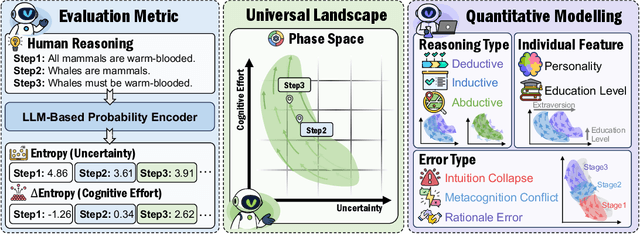
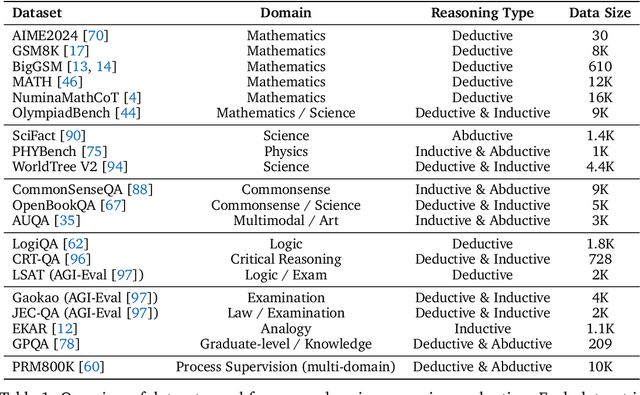
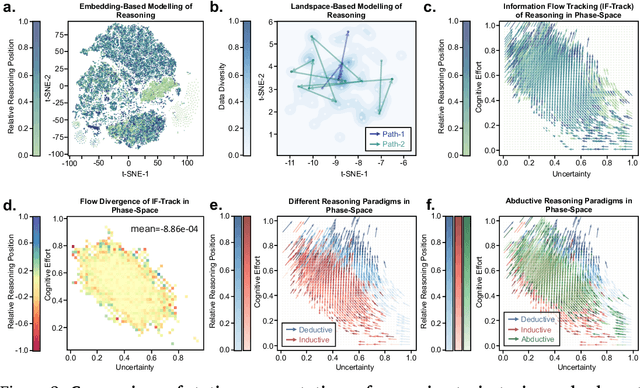
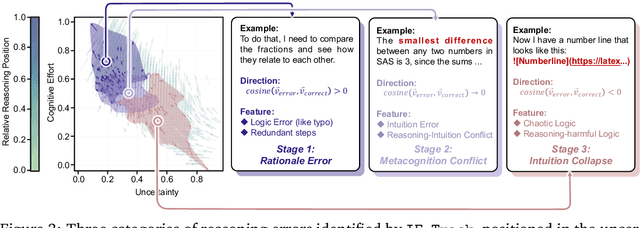
Understanding how information is dynamically accumulated and transformed in human reasoning has long challenged cognitive psychology, philosophy, and artificial intelligence. Existing accounts, from classical logic to probabilistic models, illuminate aspects of output or individual modelling, but do not offer a unified, quantitative description of general human reasoning dynamics. To solve this, we introduce Information Flow Tracking (IF-Track), that uses large language models (LLMs) as probabilistic encoder to quantify information entropy and gain at each reasoning step. Through fine-grained analyses across diverse tasks, our method is the first successfully models the universal landscape of human reasoning behaviors within a single metric space. We show that IF-Track captures essential reasoning features, identifies systematic error patterns, and characterizes individual differences. Applied to discussion of advanced psychological theory, we first reconcile single- versus dual-process theories in IF-Track and discover the alignment of artificial and human cognition and how LLMs reshaping human reasoning process. This approach establishes a quantitative bridge between theory and measurement, offering mechanistic insights into the architecture of reasoning.
AutoPR: Let's Automate Your Academic Promotion!
Oct 10, 2025As the volume of peer-reviewed research surges, scholars increasingly rely on social platforms for discovery, while authors invest considerable effort in promoting their work to ensure visibility and citations. To streamline this process and reduce the reliance on human effort, we introduce Automatic Promotion (AutoPR), a novel task that transforms research papers into accurate, engaging, and timely public content. To enable rigorous evaluation, we release PRBench, a multimodal benchmark that links 512 peer-reviewed articles to high-quality promotional posts, assessing systems along three axes: Fidelity (accuracy and tone), Engagement (audience targeting and appeal), and Alignment (timing and channel optimization). We also introduce PRAgent, a multi-agent framework that automates AutoPR in three stages: content extraction with multimodal preparation, collaborative synthesis for polished outputs, and platform-specific adaptation to optimize norms, tone, and tagging for maximum reach. When compared to direct LLM pipelines on PRBench, PRAgent demonstrates substantial improvements, including a 604% increase in total watch time, a 438% rise in likes, and at least a 2.9x boost in overall engagement. Ablation studies show that platform modeling and targeted promotion contribute the most to these gains. Our results position AutoPR as a tractable, measurable research problem and provide a roadmap for scalable, impactful automated scholarly communication.
A Survey of Self-Evolving Agents: On Path to Artificial Super Intelligence
Jul 28, 2025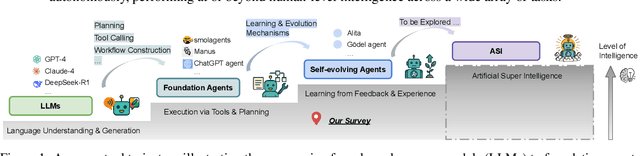

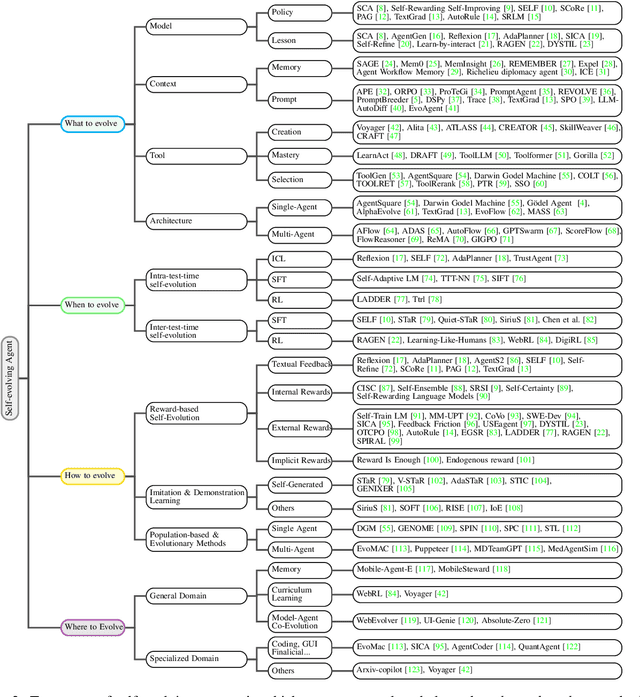
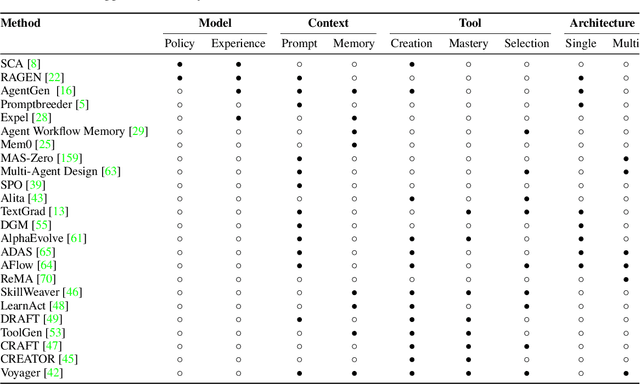
Large Language Models (LLMs) have demonstrated strong capabilities but remain fundamentally static, unable to adapt their internal parameters to novel tasks, evolving knowledge domains, or dynamic interaction contexts. As LLMs are increasingly deployed in open-ended, interactive environments, this static nature has become a critical bottleneck, necessitating agents that can adaptively reason, act, and evolve in real time. This paradigm shift -- from scaling static models to developing self-evolving agents -- has sparked growing interest in architectures and methods enabling continual learning and adaptation from data, interactions, and experiences. This survey provides the first systematic and comprehensive review of self-evolving agents, organized around three foundational dimensions -- what to evolve, when to evolve, and how to evolve. We examine evolutionary mechanisms across agent components (e.g., models, memory, tools, architecture), categorize adaptation methods by stages (e.g., intra-test-time, inter-test-time), and analyze the algorithmic and architectural designs that guide evolutionary adaptation (e.g., scalar rewards, textual feedback, single-agent and multi-agent systems). Additionally, we analyze evaluation metrics and benchmarks tailored for self-evolving agents, highlight applications in domains such as coding, education, and healthcare, and identify critical challenges and research directions in safety, scalability, and co-evolutionary dynamics. By providing a structured framework for understanding and designing self-evolving agents, this survey establishes a roadmap for advancing adaptive agentic systems in both research and real-world deployments, ultimately shedding lights to pave the way for the realization of Artificial Super Intelligence (ASI), where agents evolve autonomously, performing at or beyond human-level intelligence across a wide array of tasks.